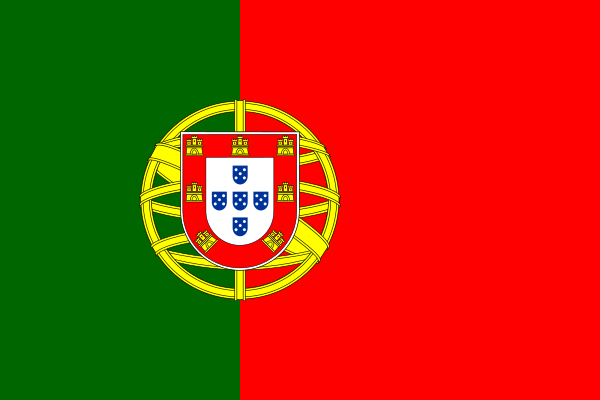
Portugal: timeline and key events
-
Politics
Arrival of the Romans in the Iberian Peninsula
Roman armies land on the Iberian Peninsula to counter Carthage during the Second Punic War. The gradual Romanisation of Lusitania (present-day Portugal) brings the Latin language, Roman law and infrastructure that lastingly mark Portuguese civilisation.
-
War
Moorish invasion of the Iberian Peninsula
Arab-Berber troops commanded by Tariq ibn Ziyad cross the Strait of Gibraltar and rapidly conquer almost all of the Iberian Peninsula. The Muslim occupation of the peninsula, which lasts until the 15th century, leaves a deep imprint on the Portuguese language and culture.
-
Politics
Foundation of the Kingdom of Portugal, Alfonso I
The Treaty of Zamora recognises Alfonso Henriques as King of Portugal, establishing the birth of an independent kingdom in the west of the Iberian Peninsula. Alfonso I, known as "the Conqueror", continues the Reconquista by pushing the Moors southwards.
-
Politics
Recognition of the Kingdom by the Pope
Pope Alexander III officially recognises the Kingdom of Portugal in the bull Manifestis Probatum, consolidating its independence on a religious and diplomatic level. This recognition confers international legitimacy on the new Iberian kingdom.
-
War
End of the Portuguese Reconquista
King Alfonso III completes the Reconquista by taking Faro in the Algarve, the last city under Moorish rule in Portugal. With this victory, the territory of present-day Portugal is fully unified under the Portuguese crown, two centuries before the end of the Spanish Reconquista.
-
War
Victory of Aljubarrota, independence preserved
King John I of Portugal defeats the Castilian army at the Battle of Aljubarrota, preserving Portuguese independence against Castilian annexation. This victory founds the House of Aviz and consolidates the Anglo-Portuguese alliance, the oldest in the world still in force.
-
Politics
Capture of Ceuta, beginning of maritime expansion
King John I conquers Ceuta in Morocco with his sons, including Henry the Navigator, opening the era of the Portuguese Great Discoveries. This first expansion beyond European borders marks the beginning of the Portuguese colonial empire.
-
Science
Bartolomeu Dias rounds the Cape of Good Hope
Portuguese navigator Bartolomeu Dias rounds the Cape of Good Hope, proving it is possible to reach Asia by sea by circumnavigating Africa. This key discovery opens the spice route and prepares for Vasco da Gama's voyage.
-
Economy
Vasco da Gama reaches India
Vasco da Gama arrives at Calicut (Kozhikode) in India after rounding Africa, establishing for the first time a direct maritime trade route between Europe and Asia. This voyage revolutionises world trade and reinforces Portuguese power.
-
Politics
Pedro Álvares Cabral discovers Brazil
Admiral Pedro Álvares Cabral, en route to the Indies, reaches the coast of what will become Brazil and takes possession of this territory in the name of Portugal. This discovery, whether accidental or deliberate, gives Portugal the greatest of its future colonies.
-
Politics
Iberian Union, Portugal under Spanish rule
King Philip II of Spain, grandson of Portuguese King Manuel I, annexes the kingdom following the dynastic crisis caused by the death of King Sebastian at the Battle of Alcácer Quibir. This Iberian Union weakens Portuguese trade and colonial routes.
-
Politics
Restoration of independence, House of Braganza
The uprising of 1 December 1640 overthrows Spanish domination and restores Portuguese independence, with the Duke of Braganza crowned King John IV. This date is still celebrated as the Portuguese National Day.
-
Other
Lisbon earthquake
A catastrophic earthquake estimated at magnitude 8.5-9, followed by a tsunami and fires, devastates Lisbon on 1 November, killing 30,000 to 60,000 people. Minister Pombal directs the reconstruction of the city on an innovative geometric plan, completely reshaping Lisbon.
-
War
Napoleonic invasion, the Royal Court flees to Brazil
Napoleon's armies invade Portugal, forcing the royal family to embark for Brazil under British escort. This flight preserves the continuity of the Portuguese colonial empire, but lastingly weakens the country on the European stage.
-
Politics
Independence of Brazil, loss of the great colony
Prince Pedro, son of Portuguese King João VI, proclaims the independence of Brazil and becomes Emperor Pedro I. This separation deprives Portugal of its largest and richest colony, but takes place without major armed conflict.
-
Politics
Proclamation of the Portuguese Republic
A revolution overthrows the monarchy and establishes the First Portuguese Republic on 5 October 1910, ending eight centuries of royalty. This date remains the Portuguese national holiday.
-
Politics
Military coup, beginning of Salazarism
A military coup overthrows the First Portuguese Republic and paves the way for the dictatorship of António de Oliveira Salazar, who governs Portugal until 1968. Salazar's Estado Novo is a corporatist, Catholic and colonial regime that keeps Portugal away from modernity.
-
Politics
Carnation Revolution, return to democracy
On 25 April 1974, a movement of army captains ("Armed Forces Movement") peacefully overthrows the Salazarist regime in the Carnation Revolution. Lisbon residents place red carnations in soldiers' rifle barrels, symbolising this bloodless revolution.
-
Politics
Independence of African colonies
In the wake of the Carnation Revolution, Portugal grants independence to its African colonies: Angola, Mozambique, Cape Verde, Guinea-Bissau and São Tomé and Príncipe. This act ends more than five centuries of Portuguese colonial empire in Africa.
-
Economy
Entry into the European Economic Community
Portugal joins the European Economic Community (future European Union) at the same time as Spain. This accession consolidates Portuguese democracy, opens access to European structural funds and integrates the country into economic and institutional modernity.