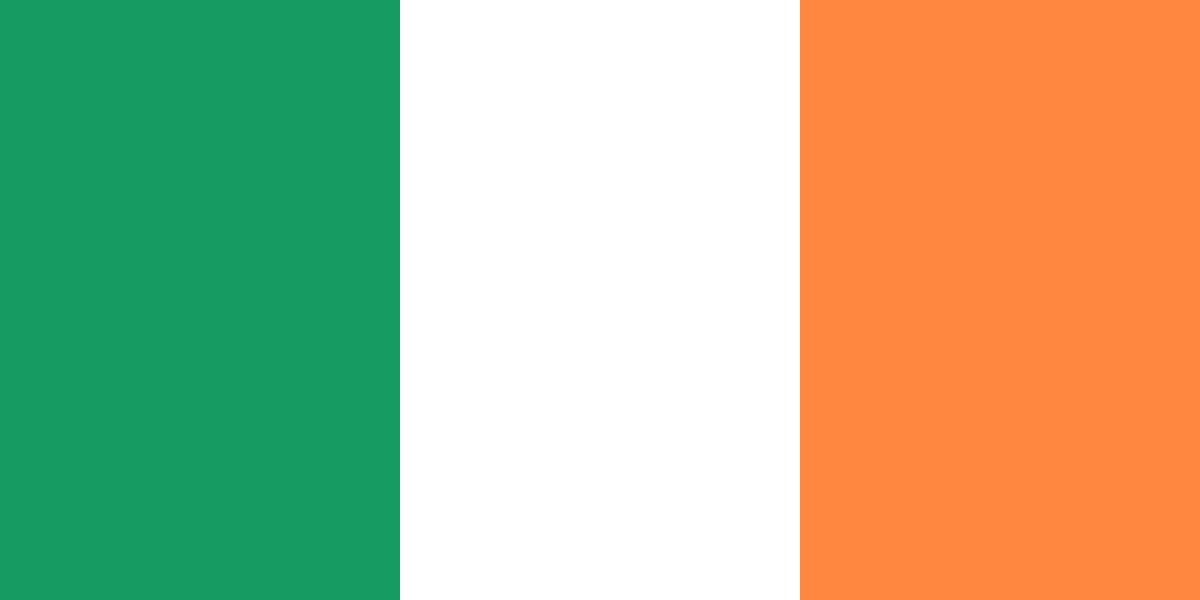
Adopted in 1922
| Capital | Dublin |
|---|---|
| Main cities | Dublin, Cork, Limerick |
| Population | 5,395,790 inh. (2024) |
| Area | 70,280 km² |
| Highest point | Carrauntoohil (1,039 m) |
| Population density | 76.8 inh./km² |
| GDP | US$609 billion (2024) |
| GDP per capita | US$112,890 (2024) |
| Human Development Index | 0.949 (ranked 11 of 193, 2023) |
| Local time | --:-- |
| Language(s) | Irish, English |
| Political system | Unitary parliamentary republic |
| National anthem | Amhrán na bhFiann (The Soldiers' Song) |
| National day | 17 March |
| Currency | Euro (EUR) |
| Calling code | +353 |
| Internet domain | .ie |
| History | View timeline |
| Land borders | United Kingdom |
| Maritime borders | Atlantic Ocean, Irish Sea |
Overview
Ireland occupies most of the island of the same name, to the west of Great Britain. Its only land border is with Northern Ireland, which is part of the United Kingdom. Nicknamed the "Emerald Isle" for its green landscapes, it faces the Atlantic with a rugged coastline, from the Cliffs of Moher to Connemara. Dublin, the capital, lies on the east coast.
Long under English and then British rule, Ireland gained independence in 1922 as the Irish Free State, before becoming a republic in 1949. The Great Famine of the 1840s led to mass emigration, particularly to the United States. A member of the European Community since 1973, the country has two official languages, Irish and English. Gaelic football and hurling are the traditional sports, and rugby is hugely popular: the Ireland team, which brings together players from both sides of the border, won the Grand Slam in the Championship in 1948, 2009, 2018 and 2023.
History at a glance
- 1801Act of Union
- 1845Great Famine
- 1916Easter Rising
- 1921Anglo-Irish Treaty
- 1998Good Friday Agreement
The flag: history and symbolism
Flag History
The Irish tricolour was first presented in 1848 by Thomas Francis Meagher, a leading figure of the Young Ireland movement. Inspired by the February Revolution of 1848 in France, he brought back from Paris a green, white and orange flag, given to him by French women sympathetic to the Irish cause, and flew it in Waterford on 7 March 1848.
For several decades, however, the flag most widely used by nationalists remained a green flag bearing a golden harp. The tricolour only gained acceptance with the Easter Rising of 1916, when it was raised over the General Post Office in Dublin, the rebels' headquarters.
The Irish Free State adopted it as its flag in 1922, and the Constitution of 1937 enshrined it in Article 7: ‘The national flag is the tricolour of green, white and orange.’
Meaning of Colours & Emblems
The meaning of the Irish flag was explained by Thomas Francis Meagher himself when he presented it in 1848:
- Green: the Gaelic tradition and the Catholic majority of the island.
- Orange: the Protestants, in reference to William of Orange, victor of the Battle of the Boyne in 1690.
- White: a lasting peace between these two communities.
The flag thus expresses an ideal of reconciliation and union between all the inhabitants of the island, beyond religious divisions.
Anecdotes & Fun Facts
The Irish flag is often confused with that of Côte d'Ivoire, which uses the same colours in reverse order: orange is at the hoist on the Ivorian flag, green on the Irish one. The Irish flag is also noticeably longer, in a 1:2 format.
The harp, long the emblem of the nationalists, has remained the official emblem of the Irish state. It faces the opposite way to that of the Guinness brewery, which adopted it as its logo in 1862 and registered it as a trademark in 1876.
Thomas Francis Meagher, sentenced to transportation to Van Diemen's Land (now Tasmania) after the rising of 1848, escaped to the United States. There he commanded the Irish Brigade during the American Civil War, then became acting governor of Montana Territory.
Similar Flags Around the World


Sport and history
Athletes
Olympic Games
History
Frequently asked questions
What is the capital of Ireland?
Dublin is the capital of Ireland.
What do the colours of the flag of Ireland mean?
The meaning of the Irish flag was explained by Thomas Francis Meagher himself when he presented it in 1848: Green: the Gaelic tradition and the Catholic majority of the island. Orange: the Protestants, in reference to William of Orange, victor of the Battle of the Boyne in 1690. White: a lasting peace between these two communities. The flag thus expresses an ideal of reconciliation and union between all the inhabitants of the island, beyond religious divisions.
Which countries border Ireland?
Ireland shares land borders with: United Kingdom.
What is the population of Ireland?
The population of Ireland is 5.4 million (120th in the world).
What is the area of Ireland?
The area of Ireland is 70,280 km² (120th in the world).