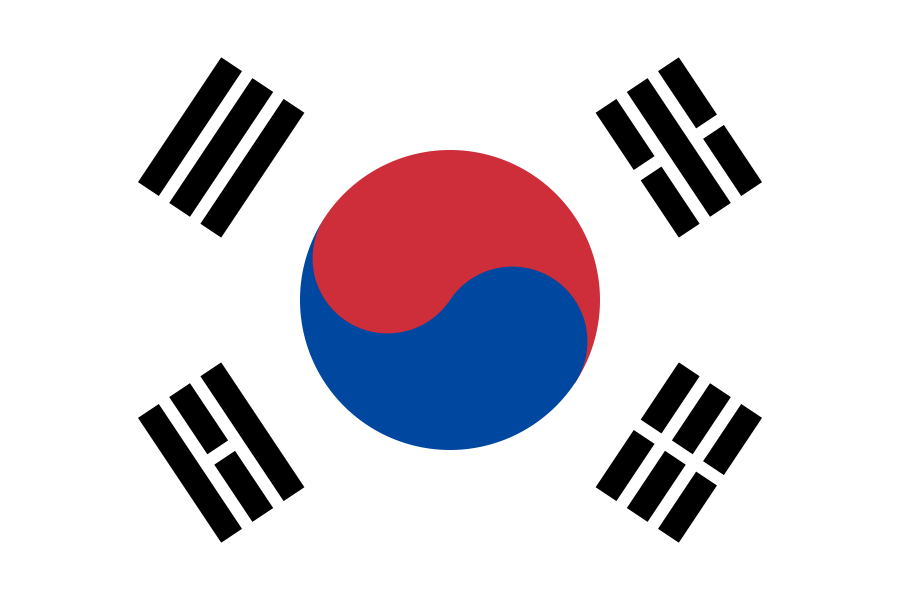
Adopted in 1949
| Capital | Seoul |
|---|---|
| Main cities | Seoul, Busan, Incheon |
| Population | 51,751,065 inh. (2024) |
| Area | 100,440 km² |
| Highest point | Hallasan (1,947 m) |
| Population density | 515.2 inh./km² |
| GDP | US$1,875 billion (2024) |
| GDP per capita | US$36,240 (2024) |
| Human Development Index | 0.937 (ranked 20 of 193, 2023) |
| Local time | --:-- |
| Language(s) | Korean |
| Political system | Unitary presidential constitutional republic |
| National motto | Benefit broadly in the human world |
| National anthem | Patriotic Song |
| Currency | South Korean won (KRW) |
| Calling code | +82 |
| Internet domain | .kr |
| History | View timeline |
| Land borders | North Korea |
| Maritime borders | Yellow Sea, Sea of Japan, East China Sea |
Overview
South Korea occupies the southern half of the Korean Peninsula in East Asia, between the Yellow Sea and the East Sea (or Sea of Japan). Its only land border, the Demilitarised Zone, separates it from North Korea. The country is mountainous and has many islands, including Jeju. Seoul, the capital, and its surrounding region are home to almost half the population.
Long ruled by the Joseon dynasty, under which the Hangul alphabet was created in the 15th century, Korea was annexed by Japan from 1910 to 1945 and then divided into two states; the Korean War (1950-1953) ended in an armistice. Within a few decades, South Korea has become a major industrial and technological power whose popular culture reaches audiences worldwide. It hosted the Summer Olympics in Seoul in 1988 and the Winter Olympics in Pyeongchang in 2018, and co-hosted the 2002 FIFA World Cup, in which it reached the semi-finals. Taekwondo originated there, and the country dominates archery.
History at a glance
- 1910Japanese annexation of Korea
- 1945Liberation and division of Korea
- 1950Invasion of South Korea
- 1953Panmunjom armistice
- 1988Seoul Olympic Games
The flag: history and symbolism
Flag History
The flag, known as the Taegukgi, dates back to 1882-1883. Its creation is generally credited to the diplomat Park Yeong-hyo, who used it during an official mission to Japan, before King Gojong officially proclaimed it the national flag of the Joseon dynasty on 27 January 1883.
The flag effectively disappeared during the Japanese occupation of Korea, between 1910 and 1945, before being restored with the founding of the Republic of Korea in 1948. Its precise proportions and geometric construction, however, were only officially fixed on 15 October 1949, through a government regulation meant to end the various inconsistent versions then in circulation.
Meaning of Colours & Emblems
The white field draws on a colour traditionally associated with Korea, a land long nicknamed "the nation of white clothing," a symbol of peace and purity.
At the centre, the Taegeuk, a red and blue circle inspired by the Taoist symbol of yin and yang, represents the balance and harmony of the universe's opposing forces.
Black trigrams borrowed from the I Ching, the classic Chinese book of changes, sit in each corner: those representing heaven and earth face each other diagonally, as do those representing water and fire, each pair symbolising balance between opposite and complementary forces.
Anecdotes & Fun Facts
The exact authorship of the Taegukgi is still debated by historians: some sources credit the diplomat Park Yeong-hyo, while others point to another member of the same 1882 diplomatic mission, Lee Eung-jun, who is said to have proposed the initial design.
The flag shares its name, Taegukgi, with the yin-yang symbol at its centre, meaning literally "the flag of the Great Ultimate."
During the Japanese colonisation of Korea, between 1910 and 1945, the Japanese authorities banned the use of the Taegukgi, turning it into a symbol of national resistance before its official rehabilitation after the Second World War.
Flags of Neighbouring Countries

Sport and history
Athletes
Olympic Games
History
Frequently asked questions
What is the capital of South Korea?
Seoul is the capital of South Korea.
What do the colours of the flag of South Korea mean?
The white field draws on a colour traditionally associated with Korea, a land long nicknamed "the nation of white clothing," a symbol of peace and purity. At the centre, the Taegeuk, a red and blue circle inspired by the Taoist symbol of yin and yang, represents the balance and harmony of the universe's opposing forces. Black trigrams borrowed from the I Ching, the classic Chinese book of changes, sit in each corner: those representing heaven and earth face each other diagonally, as do those representing water and fire, each pair symbolising balance between opposite and complementary forces.
Which countries border South Korea?
South Korea shares land borders with: North Korea.
What is the population of South Korea?
The population of South Korea is 51.8 million (29th in the world).
What is the area of South Korea?
The area of South Korea is 100,440 km² (108th in the world).