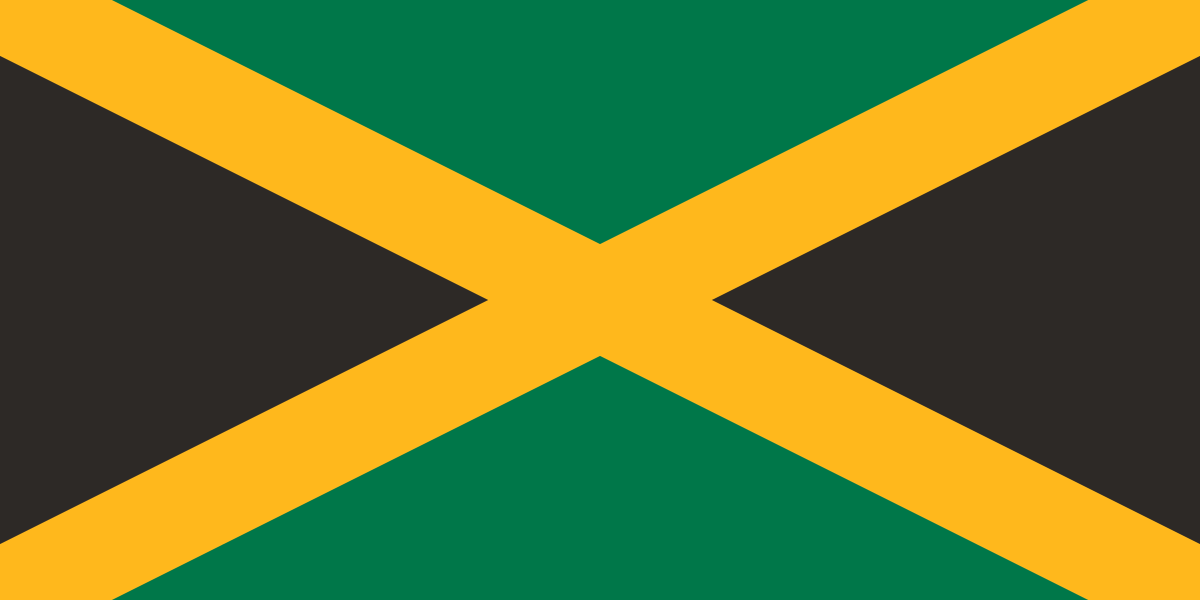
Adopted in 1962
| Capital | Kingston |
|---|---|
| Population | 2 839 175 inh. |
| Area | 10 990 km² |
| Population density | 258.3 inh./km² |
| Local time | --:-- |
| Language(s) | English |
| Political system | Unitary parliamentary constitutional monarchy |
| National motto | Out of Many, One People |
| National anthem | Jamaica, Land We Love |
| Currency | Jamaican dollar (JMD) |
| Maritime borders | Caribbean Sea |
The flag: history and symbolism
Flag History
The Jamaican flag was adopted on 6 August 1962, the day Jamaica, a former British colony, became independent. It was designed by a parliamentary committee bringing together the country's two main parties.
An initial design with horizontal stripes was dropped because it looked too much like the flag of Tanganyika, now Tanzania. The committee finally chose a gold saltire (St Andrew's cross), which divides the flag into four triangles, green at the top and bottom, black at the hoist and the fly.
The flag has not changed since independence, but the official interpretation of its colours was later revised.
Meaning of Colours & Emblems
Originally, the flag was summed up by the phrase: ‘Hardships there are, but the land is green and the sun shineth.’ The current interpretation is more positive:
- Black: the strength and creativity of the Jamaican people; it originally stood for the hardships overcome.
- Gold: the sunlight and the island's natural wealth.
- Green: hope and the country's agricultural resources.
Anecdotes & Fun Facts
Since Mauritania added red to its flag in 2017, Jamaica has had the only national flag that contains no red, white or blue.
Black, gold and green, together with red, have become emblematic colours of reggae and Rastafarian culture, which has made the Jamaican flag famous far beyond the island.
Jamaican athletes such as Usain Bolt have made the Jamaican flag one of the most familiar sights at the Olympic Games and the World Athletics Championships.
Sport and history
Olympic Games
Frequently asked questions
What is the capital of Jamaica?
Kingston is the capital of Jamaica.
What do the colours of the flag of Jamaica mean?
Originally, the flag was summed up by the phrase: ‘Hardships there are, but the land is green and the sun shineth.’ The current interpretation is more positive: Black: the strength and creativity of the Jamaican people; it originally stood for the hardships overcome. Gold: the sunlight and the island's natural wealth. Green: hope and the country's agricultural resources.