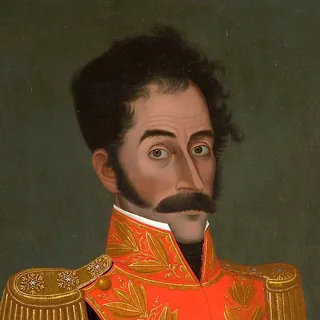
Simón Bolívar
Key Facts
- Born on 24 July 1783 in Caracas, into a Creole family
- Given the title of Liberator in 1813, after the Admirable Campaign
- Freed New Granada at the Battle of Boyacá on 7 August 1819
- President of Gran Colombia, proclaimed on 17 December 1819
- Freed Venezuela at the Battle of Carabobo on 24 June 1821
- Gave his name to Bolivia, proclaimed a republic in 1825
- Died on 17 December 1830 near Santa Marta, Colombia
Biography
Simón Bolívar (1783-1830), known as the Liberator, is the leading figure of South America's wars of independence against Spain. His campaigns led to the independence of six present-day countries (Venezuela, Colombia, Ecuador, Panama, Peru and Bolivia, which bears his name), but his dream of a great union of the Spanish American republics did not outlive him.
Born on 24 July 1783 in Caracas into a wealthy Creole family of the Captaincy General of Venezuela, he lost his father in 1786 and his mother in 1792. A pupil of the educator Simón Rodríguez, he travelled to Europe and in 1802 married María Teresa Rodríguez del Toro in Madrid; she died of a fever in Caracas in January 1803. Back in Europe, he swore an oath in Rome in 1805 to free his country from Spanish rule. After the Captain General was deposed in Caracas in April 1810, he was sent on a mission to London; Venezuela declared its independence on 5 July 1811, but this First Republic collapsed as early as 1812.
Taking refuge in Cartagena de Indias, he wrote a manifesto drawing the lessons of this failure, then reconquered Venezuela in the “Admirable Campaign” of 1813: having entered Caracas in August, he was given the title of Liberator there in October. Defeated in 1814, he went into exile in Jamaica, where in September 1815 he wrote a famous letter on the future of Spanish America, and then in Haiti, whose president, Alexandre Pétion, gave him support in return for a promise to abolish slavery. In 1819 he crossed the Andes and on 7 August won the Battle of Boyacá, which freed New Granada; on 17 December the Congress of Angostura proclaimed the Republic of Colombia, known as Gran Colombia, with Bolívar as its president. His victory at Carabobo on 24 June 1821 freed Venezuela.
His lieutenant Antonio José de Sucre liberated Ecuador in 1822, the year in which Bolívar met the Argentine general José de San Martín at Guayaquil. He completed the liberation of Peru with the victories of Junín, on 6 August 1824, and Ayacucho, won by Sucre on 9 December; in 1825 Upper Peru became a republic that took the name of Bolivia. But the Congress of Panama in 1826 failed to unite the new states, and regional rivalries undermined Gran Colombia. Having assumed dictatorial powers in 1828, he escaped an assassination attempt in Bogotá on 25 September thanks to his companion, Manuela Sáenz. In 1830 Venezuela and Ecuador seceded; in poor health, Bolívar gave up power and died of tuberculosis on 17 December 1830 near Santa Marta, Colombia, aged forty-seven.
Shortly before his death he wrote that those who had served the revolution had “ploughed the sea”. His remains were brought back to Caracas in 1842 and moved to the National Pantheon in 1876. Regarded as the father of several nations, he gave his name to Bolivia, to Venezuela's currency, the bolívar, and to the Bolivarian Republic of Venezuela, the country's official name since 1999; political movements of every persuasion still claim his legacy.