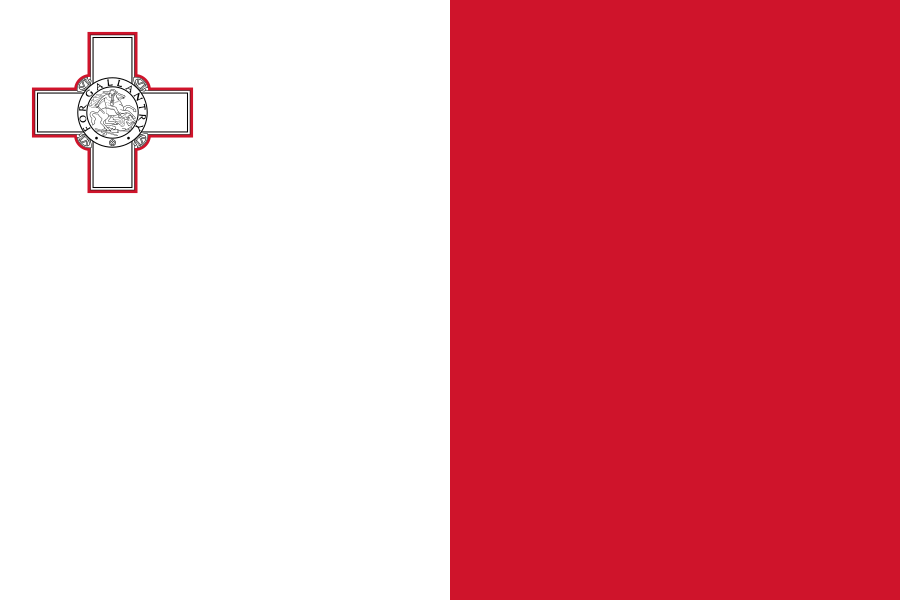
Adopted in 1964
| Capital | Valletta |
|---|---|
| Population | 574 346 inh. |
| Area | 320 km² |
| Population density | 1794.8 inh./km² |
| Local time | --:-- |
| Language(s) | Maltese, English |
| Political system | Unitary parliamentary republic |
| National anthem | L-Innu Malti (The Maltese Hymn) |
| Currency | Euro (EUR) |
| Maritime borders | Mediterranean Sea |
The flag: history and symbolism
Flag History
White and red have been associated with Malta since the Middle Ages; tradition links them to the Norman Count Roger de Hauteville, who is said to have given the Maltese part of his red and white banner in 1091.
During the Second World War, on 15 April 1942, King George VI awarded the whole island the George Cross for the courage of its people under the bombing of the Siege of Malta.
The current flag was adopted on 21 September 1964, the day Malta became independent. The George Cross, edged in red, appears in the upper corner at the hoist.
Meaning of Colours & Emblems
The elements of the Maltese flag have a well-established meaning:
- White and red: the traditional colours of Malta, which tradition traces back to the Normans.
- George Cross: the British decoration for civilian gallantry, awarded to the island in 1942.
Anecdotes & Fun Facts
Malta is the only country whose national flag bears a decoration for bravery.
The eight-pointed Maltese cross, symbol of the Order of St John, which ruled the island from 1530 to 1798, does not appear on the national flag, but it remains one of the country's best-known emblems.
The Maltese flag resembles those of Monaco, Indonesia and Poland in its two colours, but its stripes are vertical.
Frequently asked questions
What is the capital of Malta?
Valletta is the capital of Malta.
What do the colours of the flag of Malta mean?
The elements of the Maltese flag have a well-established meaning: White and red: the traditional colours of Malta, which tradition traces back to the Normans. George Cross: the British decoration for civilian gallantry, awarded to the island in 1942.