| Capital | Seoul |
|---|---|
| Population | 51 751 065 inh. |
| Area | 100 440 km² |
| Population density | 515.2 inh./km² |
| Local time | --:-- |
| Language(s) | Korean |
| Political system | Unitary presidential constitutional republic |
| National motto | Benefit broadly in the human world |
| National anthem | Patriotic Song |
| Currency | South Korean won (KRW) |
| Land borders | Korea, North |
| Maritime borders | Yellow Sea, Sea of Japan, East China Sea |
The flag: history and symbolism
Flag History
The flag, known as the Taegukgi, dates back to 1882-1883. Its creation is generally credited to the diplomat Park Yeong-hyo, who used it during an official mission to Japan, before King Gojong officially proclaimed it the national flag of the Joseon dynasty on 27 January 1883.
The flag effectively disappeared during the Japanese occupation of Korea, between 1910 and 1945, before being restored with the founding of the Republic of Korea in 1948. Its precise proportions and geometric construction, however, were only officially fixed on 15 October 1949, through a government regulation meant to end the various inconsistent versions then in circulation.
Meaning of Colors & Emblems
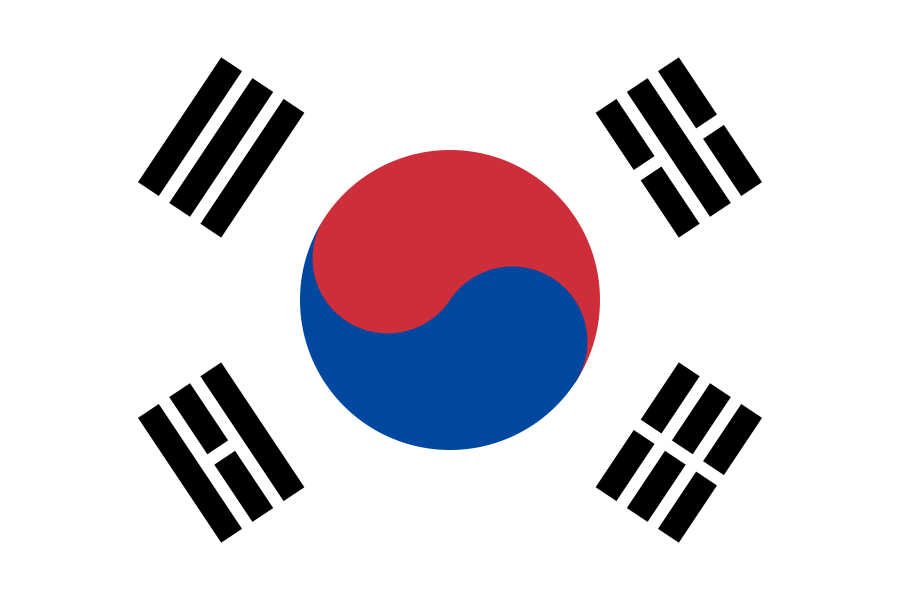
The white field draws on a color traditionally associated with Korea, a land long nicknamed "the nation of white clothing," a symbol of peace and purity.
At the center, the Taegeuk, a red and blue circle inspired by the Taoist symbol of yin and yang, represents the balance and harmony of the universe's opposing forces.
Black trigrams borrowed from the I Ching, the classic Chinese book of changes, sit in each corner: those representing heaven and earth face each other diagonally, as do those representing water and fire, each pair symbolizing balance between opposite and complementary forces.
Anecdotes & Fun Facts
The exact authorship of the Taegukgi is still debated by historians: some sources credit the diplomat Park Yeong-hyo, while others point to another member of the same 1882 diplomatic mission, Lee Eung-jun, who is said to have proposed the initial design.
The flag shares its name, Taegukgi, with the yin-yang symbol at its center, meaning literally "the flag of the Great Ultimate."
During the Japanese colonization of Korea, between 1910 and 1945, the Japanese authorities banned the use of the Taegukgi, turning it into a symbol of national resistance before its official rehabilitation after the Second World War.
Frequently asked questions
What is the capital of Korea, South?
Seoul is the capital of Korea, South.
What do the colors of the Korea, South flag mean?
The white field draws on a color traditionally associated with Korea, a land long nicknamed "the nation of white clothing," a symbol of peace and purity.At the center, the Taegeuk, a red and blue circle inspired by the Taoist symbol of yin and yang, represents the balance and harmony of the universe's opposing forces.Black trigrams borrowed from the I Ching, the classic Chinese book of changes, sit in each corner: those representing heaven and earth face each other diagonally, as do those representing water and fire, each pair symbolizing balance between opposite and complementary forces.
Which countries border Korea, South?
Korea, South shares land borders with: Korea, North.