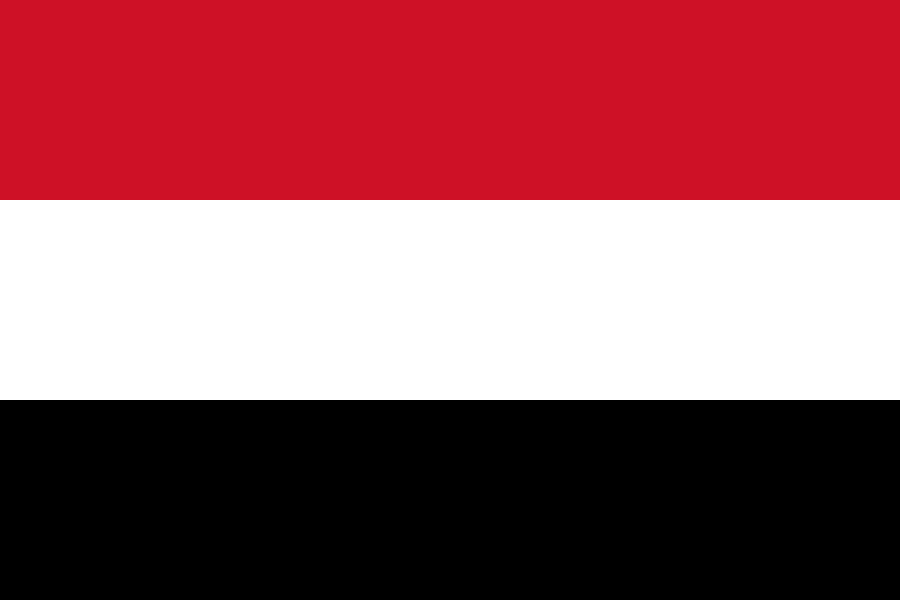
Adopted in 1990
| Capital | Sana'a |
|---|---|
| Population | 40 583 164 inh. |
| Area | 527 970 km² |
| Population density | 76.9 inh./km² |
| Local time | --:-- |
| Language(s) | Arabic |
| Political system | Republic |
| National motto | God, Country, Revolution, Unity |
| National anthem | United Republic |
| Currency | Yemeni rial (YER) |
| Land borders | Saudi Arabia, Oman |
| Maritime borders | Gulf of Aden, Red Sea |
The flag: history and symbolism
Flag History
The flag of Yemen was adopted on 22 May 1990, the day North Yemen and South Yemen, which had previously used different flags, were unified.
The new flag takes up the red, white and black stripes common to the two previous flags, removing their emblems: the green star of the North and the blue triangle with a red star of the South.
The flag consists of three horizontal stripes of equal width, red, white and black.
Meaning of Colours & Emblems
The pan-Arab colours of the Yemeni flag are generally interpreted as follows:
- Red: the blood of the martyrs and the unity of the country.
- White: a bright future.
- Black: the dark days of the past.
Anecdotes & Fun Facts
The Yemeni flag is the simplest of the flags in the colours of Arab liberation: it bears no emblem, unlike those of Egypt, Iraq and Sudan.
22 May, the day of unification, is Yemen's national day.
The Yemeni flag is almost identical to that of Egypt, from which it differs only in lacking the Eagle of Saladin.
Similar Flags Around the World


Sport and history
National teams
Frequently asked questions
What is the capital of Yemen?
Sana'a is the capital of Yemen.
What do the colours of the flag of Yemen mean?
The pan-Arab colours of the Yemeni flag are generally interpreted as follows: Red: the blood of the martyrs and the unity of the country. White: a bright future. Black: the dark days of the past.
Which countries border Yemen?
Yemen shares land borders with: Saudi Arabia, Oman.