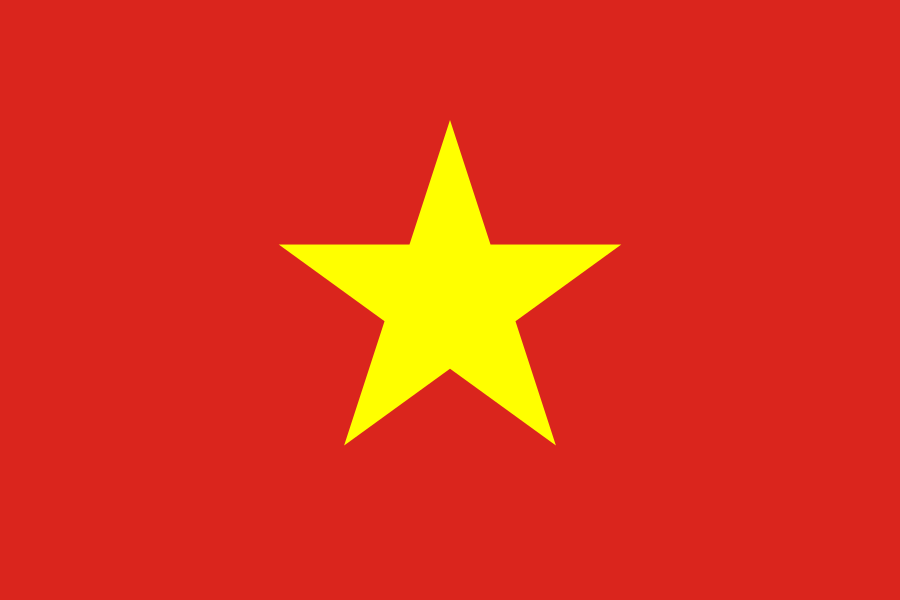
Adopted in 1976
| Capital | Hanoi |
|---|---|
| Population | 100 987 686 inh. |
| Area | 331 340 km² |
| Population density | 304.8 inh./km² |
| Local time | --:-- |
| Language(s) | Vietnamese |
| Political system | Marxist-Leninist one-party socialist republic |
| National motto | Doc lâp, tu do, hanh phúc (Independence, Freedom, Happiness) |
| National anthem | Tien Quân Ca (Army March) |
| Currency | Vietnamese dong (VND) |
| Land borders | China, Laos, Cambodia |
| Maritime borders | South China Sea, Gulf of Thailand |
The flag: history and symbolism
Flag History
According to the most common account, the red flag with a yellow star first appeared during the Cochinchina (Nam Kỳ) uprising of November 1940 against the French colonial administration. It was then adopted by the Viet Minh, the independence front led by Ho Chi Minh.
After the August Revolution, it became the flag of the Democratic Republic of Vietnam in September 1945. In 1955, the shape of the star was redrawn, with more slender points.
After the country's reunification, it was adopted on 2 July 1976 as the flag of the Socialist Republic of Vietnam.
Meaning of Colours & Emblems
The elements of the Vietnamese flag have an official meaning:
- Red: the revolution and the blood shed for the country's independence.
- Yellow star: the leadership of the Party and the unity of the people; its five points represent intellectuals, farmers, workers, traders and soldiers.
Anecdotes & Fun Facts
At the country's northernmost point, the Lũng Cú flagpole, on the Chinese border, flies a flag measuring 54 square metres, in tribute to the 54 ethnic groups officially recognised in Vietnam.
The Vietnamese flag is often compared with that of China, which also combines red and yellow, but with five stars placed in the canton.
The flag is everywhere during the major national holidays, such as 2 September, the anniversary of Ho Chi Minh's proclamation of independence in 1945, when it decorates the streets of every town.
Similar Flags Around the World

Sport and history
Olympic Games
Frequently asked questions
What is the capital of Vietnam?
Hanoi is the capital of Vietnam.
What do the colours of the flag of Vietnam mean?
The elements of the Vietnamese flag have an official meaning: Red: the revolution and the blood shed for the country's independence. Yellow star: the leadership of the Party and the unity of the people; its five points represent intellectuals, farmers, workers, traders and soldiers.