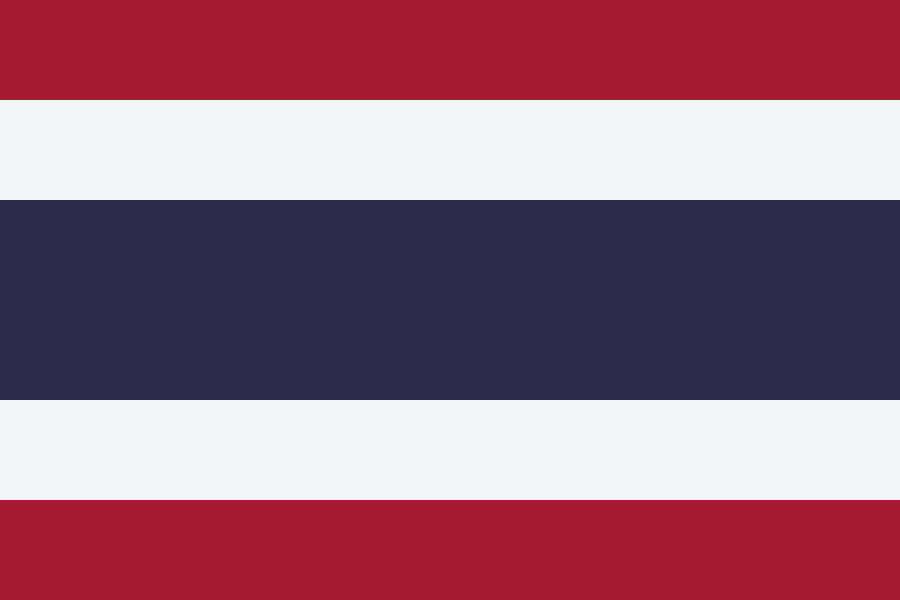
Adopted in 1917
| Capital | Bangkok |
|---|---|
| Population | 71 668 011 inh. |
| Area | 513 120 km² |
| Population density | 139.7 inh./km² |
| Local time | --:-- |
| Language(s) | Thai |
| Political system | Unitary parliamentary constitutional monarchy |
| National anthem | Phleng Chat |
| Currency | Thai baht (THB) |
| Land borders | Myanmar, Malaysia, Cambodia, Laos |
| Maritime borders | Gulf of Thailand, Strait of Malacca, Andaman Sea |
The flag: history and symbolism
Flag History
In the 19th century, the Kingdom of Siam used a red flag bearing a white elephant, a sacred animal and a symbol of royalty. In 1916 and 1917, King Vajiravudh (Rama VI) first replaced it with a flag of red and white stripes.
On 28 September 1917, the central stripe became blue: the current flag, called the Trairanga (‘tricolour’), was born. It has five horizontal stripes, red, white, blue, white and red, with the blue stripe twice as wide as the others.
Siam, which took the name Thailand in 1939, was never colonised, and this flag has remained unchanged for more than a century.
Meaning of Colours & Emblems
The Thai flag illustrates the three pillars of the country, ‘Nation, Religion, King’:
- Red: the nation and the blood shed in its defence.
- White: religion, and Buddhism in particular.
- Blue: the monarchy. Blue is often described as King Vajiravudh's personal colour.
The addition of blue in 1917 is often presented as a gesture of solidarity with the Allies, France, the United Kingdom and the United States, whose flags are red, white and blue: Siam had just entered the First World War on their side, in July 1917.
Anecdotes & Fun Facts
Every day at 8 a.m. and 6 p.m., the national anthem is broadcast on radio, on television and in many public places while the flag is raised or lowered. It is customary to stop and stand still for its whole duration.
In 2017, to mark the flag's centenary, 28 September became National Thai Flag Day.
The Thai flag resembles that of Costa Rica, which also has five horizontal stripes with a wide central band, but with the colours reversed: blue, white, red, white and blue.
Similar Flags Around the World

Sport and history
Frequently asked questions
What is the capital of Thailand?
Bangkok is the capital of Thailand.
What do the colours of the flag of Thailand mean?
The Thai flag illustrates the three pillars of the country, ‘Nation, Religion, King’: Red: the nation and the blood shed in its defence. White: religion, and Buddhism in particular. Blue: the monarchy. Blue is often described as King Vajiravudh's personal colour. The addition of blue in 1917 is often presented as a gesture of solidarity with the Allies, France, the United Kingdom and the United States, whose flags are red, white and blue: Siam had just entered the First World War on their side, in July 1917.