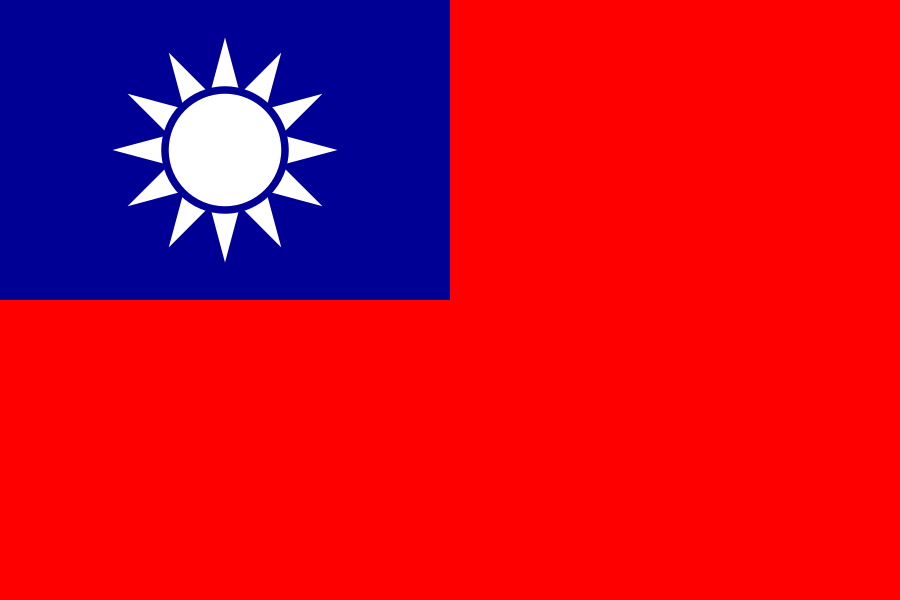
Adopted in 1928
| Capital | Taipei |
|---|---|
| Population | 23 519 518 inh. |
| Area | 36 197 km² |
| Population density | 649.8 inh./km² |
| Local time | --:-- |
| Language(s) | Standard Chinese |
| Political system | Unitary semi-presidential constitutional republic |
| National anthem | San Min Chu-i |
| Currency | New Taiwan dollar (TWD) |
| Maritime borders | South China Sea |
The flag: history and symbolism
Flag History
The ‘Blue Sky, White Sun and a Wholly Red Earth’ flag is that of the Republic of China. The blue canton with the white sun was designed in 1895 by the revolutionary Lu Haodong, and Sun Yat-sen later added the red field.
It officially became the national flag of the Republic of China in 1928. After the communist victory on the mainland in 1949, the government of the Republic of China withdrew to Taiwan, where this flag is still in use.
The blue canton with the white sun is also, on its own, the emblem of the Kuomintang, the party founded by Sun Yat-sen.
Meaning of Colours & Emblems
The elements of the flag are linked to Sun Yat-sen's ‘Three Principles of the People’:
- Blue: nationalism and liberty.
- White: democracy and equality.
- Red: the people's livelihood and fraternity, as well as the blood of the revolutionaries.
- Twelve rays of the sun: the twelve months of the year and the twelve double hours of the traditional Chinese day, a symbol of constant progress.
Anecdotes & Fun Facts
At the Olympic Games, Taiwan's athletes have competed since the 1980s under the name ‘Chinese Taipei’ and under a special flag, featuring a plum blossom and the Olympic rings, rather than under this national flag.
Lu Haodong, who designed the white sun, was executed in 1895 after a failed uprising in Canton; in Taiwan he is regarded as one of the first martyrs of the republican revolution.
10 October, the national day, commemorates the Wuchang Uprising of 1911, which led to the end of the empire and the birth of the Republic of China.
Sport and history
Frequently asked questions
What is the capital of Taiwan?
Taipei is the capital of Taiwan.
What do the colours of the flag of Taiwan mean?
The elements of the flag are linked to Sun Yat-sen's ‘Three Principles of the People’: Blue: nationalism and liberty. White: democracy and equality. Red: the people's livelihood and fraternity, as well as the blood of the revolutionaries. Twelve rays of the sun: the twelve months of the year and the twelve double hours of the traditional Chinese day, a symbol of constant progress.