Adopted in 1972
| Capital | Sri Jayawardenapura Kotte |
|---|---|
| Population | 21 916 000 inh. |
| Area | 65 610 km² |
| Population density | 334.0 inh./km² |
| Local time | --:-- |
| Language(s) | Tamil, Sinhalese |
| Political system | Unitary semi-presidential constitutional republic |
| National anthem | Sri Lanka Matha (Mother Sri Lanka) |
| Currency | Sri Lankan rupee (LKR) |
| Maritime borders | Indian Ocean |
The flag: history and symbolism
Flag History
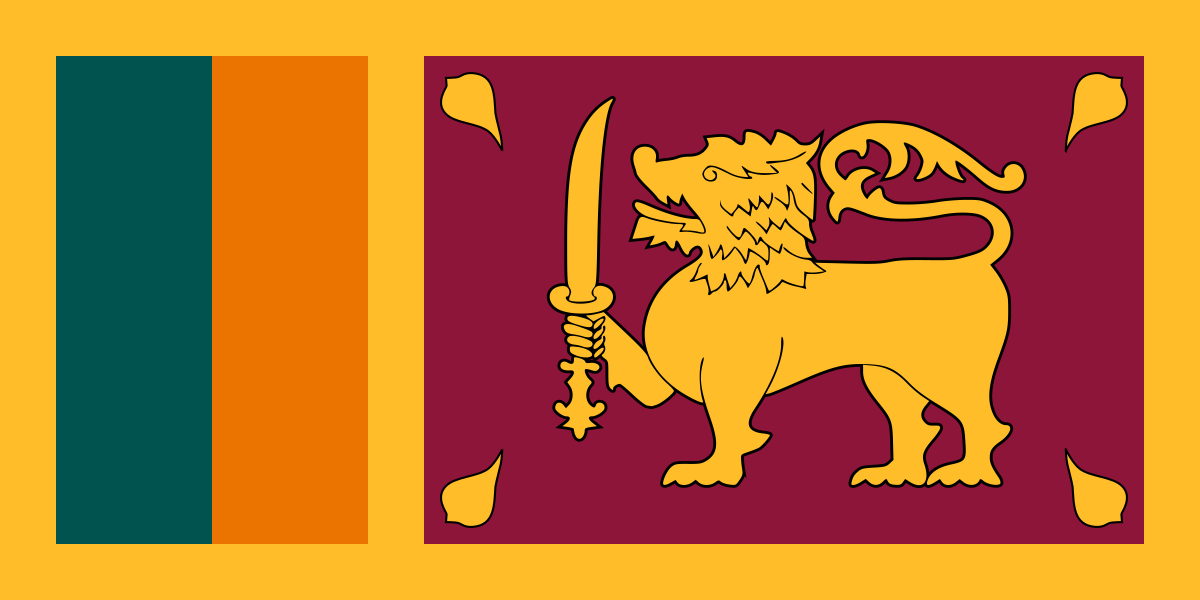
The flag of Sri Lanka is based on the lion banner of the last Sinhalese kingdom, Kandy, whose king, Sri Vikrama Rajasinha, was deposed by the British in 1815.
After Ceylon became independent in 1948, a committee adopted in the early 1950s a flag featuring the lion, to which two vertical stripes, green and saffron, were added to represent the country's minorities.
In 1972, when Ceylon became the Republic of Sri Lanka, four leaves of the Bodhi tree were placed in the corners of the maroon field. This is the current flag.
Meaning of Colours & Emblems
Each element of the Sri Lankan flag has an official meaning:
- Lion holding a sword: the Sinhalese people and the bravery of the nation.
- Maroon field: the Sinhalese majority.
- Saffron stripe: the Tamil minority.
- Green stripe: the Muslim minority.
- Four Bodhi leaves: the four virtues of Buddhism: loving kindness, compassion, sympathetic joy and equanimity.
Anecdotes & Fun Facts
The Bodhi tree is the one under which the Buddha is said to have attained enlightenment; a cutting planted at Anuradhapura in the 3rd century BC is thought to be the oldest human-planted tree with a known history.
The Sri Lankan flag is often described as one of the oldest in its elements, since the lion banner was already used by the island's kings centuries before colonisation.
The original Kandy lion banner, taken by the British in 1815, is reportedly kept in the United Kingdom.
Sport and history
Olympic Games
Frequently asked questions
What is the capital of Sri Lanka?
Sri Jayawardenapura Kotte is the capital of Sri Lanka.
What do the colours of the flag of Sri Lanka mean?
Each element of the Sri Lankan flag has an official meaning: Lion holding a sword: the Sinhalese people and the bravery of the nation. Maroon field: the Sinhalese majority. Saffron stripe: the Tamil minority. Green stripe: the Muslim minority. Four Bodhi leaves: the four virtues of Buddhism: loving kindness, compassion, sympathetic joy and equanimity.