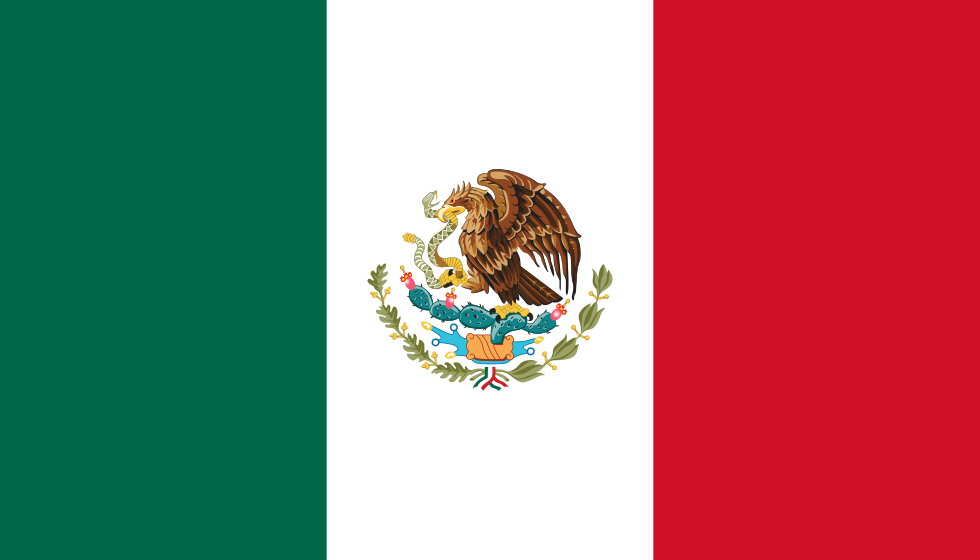
Adopted in 1968
| Capital | Mexico City |
|---|---|
| Population | 130 861 007 inh. |
| Area | 1 964 380 km² |
| Population density | 66.6 inh./km² |
| Local time | --:-- (multiple time zones) |
| Language(s) | Spanish |
| Political system | Federal presidential constitutional republic |
| National anthem | Himno Nacional Mexicano |
| Currency | Mexican peso (MXN) |
| History | View timeline |
| Land borders | Guatemala, Belize, United States |
| Maritime borders | Pacific Ocean, Gulf of Mexico, Caribbean Sea |
The flag: history and symbolism
Flag History
Green, white and red first appeared in 1821, at the end of the War of Independence against Spain, on the flag of the Army of the Three Guarantees, commanded by Agustín de Iturbide. These three guarantees, set out in the Plan of Iguala of 24 February 1821, were religion, independence and union.
Since independence, the centre of the flag has borne an emblem inspired by the legend of the founding of Tenochtitlan, the Aztec capital: a golden eagle, perched on a prickly pear cactus (nopal) growing on a rock in the middle of a lake, devouring a snake. The design of this emblem was altered several times during the 19th and 20th centuries.
The current design was adopted on 16 September 1968, a few weeks before the Mexico City Olympic Games, and then confirmed by the law of 24 February 1984 on the national coat of arms, flag and anthem.
Meaning of Colours & Emblems
The colours of the Mexican flag have received two successive interpretations:
- Green: originally independence, today more often hope.
- White: originally the Catholic religion, today unity or purity.
- Red: originally the union of all the country's inhabitants, today the blood of the nation's heroes.
- Central emblem: it illustrates the legend according to which the god Huitzilopochtli told the Mexica to found their city where they saw an eagle devouring a snake on a prickly pear cactus.
Anecdotes & Fun Facts
The Mexican flag is often confused with that of Italy, which uses the same colours. The Mexican flag stands out with its central emblem, darker shades and a longer 4:7 format.
24 February is Flag Day in Mexico. Every Monday, schoolchildren pay ‘honours to the flag’ (honores a la bandera), a ceremony during which they pledge allegiance to it.
Since the late 1990s, Mexico has installed ‘monumental flags’ in many cities, flown on poles several dozen metres high, some of which rank among the largest in the world.
Similar Flags Around the World

Sport and history
Athletes
Clubs
Olympic Games
History
Frequently asked questions
What is the capital of Mexico?
Mexico City is the capital of Mexico.
What do the colours of the flag of Mexico mean?
The colours of the Mexican flag have received two successive interpretations: Green: originally independence, today more often hope. White: originally the Catholic religion, today unity or purity. Red: originally the union of all the country's inhabitants, today the blood of the nation's heroes. Central emblem: it illustrates the legend according to which the god Huitzilopochtli told the Mexica to found their city where they saw an eagle devouring a snake on a prickly pear cactus.
Which countries border Mexico?
Mexico shares land borders with: Guatemala, Belize, United States.