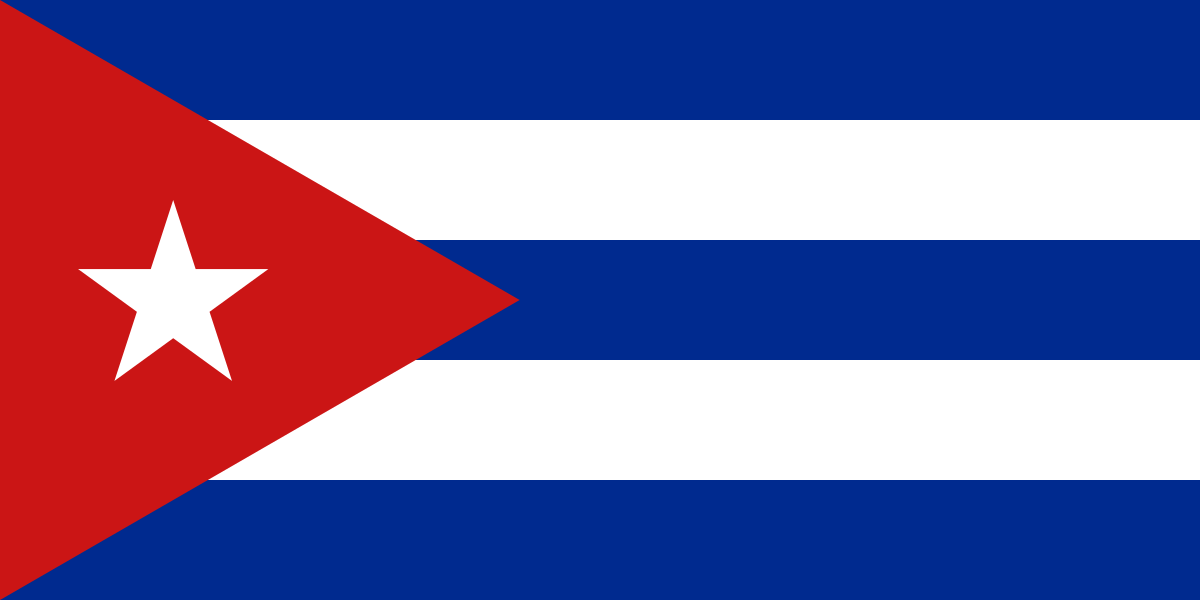
Adopted in 1902
| Capital | Havana |
|---|---|
| Population | 10 979 783 inh. |
| Area | 109 880 km² |
| Population density | 99.9 inh./km² |
| Local time | --:-- |
| Language(s) | Spanish |
| Political system | Unitary Marxist–Leninist Socialist state |
| National motto | ¡Patria o muerte, venceremos! (Homeland or Death, we shall overcome!) |
| National anthem | Himno de Bayamo (La Bayamesa) |
| Currency | Cuban peso (CUP) |
| Maritime borders | Caribbean Sea, Gulf of Mexico, Atlantic Ocean |
The flag: history and symbolism
Flag History
The Cuban flag, known as ‘the Lone Star’ (la Estrella Solitaria), was designed in 1849 in New York by General Narciso López, together with the poet Miguel Teurbe Tolón, for an expedition to free Cuba from Spanish rule.
It was raised for the first time on 19 May 1850, at Cárdenas, when López landed. During the Ten Years' War, the Assembly of Guáimaro made it the flag of the Republic in Arms in 1869.
It became Cuba's official flag on 20 May 1902, when the Republic was proclaimed, and has not changed since.
Meaning of Colours & Emblems
The elements of the Cuban flag have a well-established meaning:
- Three blue stripes: the three departments of colonial Cuba.
- Two white stripes: the purity of the independence cause.
- Red triangle: the blood shed for freedom; its shape also evokes the ideals of liberty, equality and fraternity.
- White star: independence and the unity of the Cuban people.
Anecdotes & Fun Facts
The flag of Puerto Rico, adopted in 1895 by Puerto Rican independence activists in exile in New York, takes up the design of the Cuban flag with the colours reversed: red stripes and a blue triangle.
The flag raised by Carlos Manuel de Céspedes at La Demajagua on 10 October 1868, at the start of the Ten Years' War, is the other great symbol of Cuban independence: it is preserved and displayed in the National Assembly.
Narciso López, who was born in Venezuela, was captured and executed in Havana in 1851, during another expedition.
Sport and history
National teams
Olympic Games
Frequently asked questions
What is the capital of Cuba?
Havana is the capital of Cuba.
What do the colours of the flag of Cuba mean?
The elements of the Cuban flag have a well-established meaning: Three blue stripes: the three departments of colonial Cuba. Two white stripes: the purity of the independence cause. Red triangle: the blood shed for freedom; its shape also evokes the ideals of liberty, equality and fraternity. White star: independence and the unity of the Cuban people.