Adopted in 1960
| Capital | Dakar |
|---|---|
| Population | 18 501 984 inh. |
| Area | 196 710 km² |
| Population density | 94.1 inh./km² |
| Local time | --:-- |
| Language(s) | French |
| Political system | Semi-presidential republic |
| National motto | Un Peuple, Un But, Une Foi (One People, One Goal, One Faith) |
| National anthem | Le Lion rouge (The red lion) |
| Currency | West African CFA franc (XOF) |
| Land borders | Mauritania, Mali, Guinea, Guinea-Bissau, Gambia |
| Maritime borders | Atlantic Ocean |
The flag: history and symbolism
Flag History
In 1959, Senegal and French Sudan joined together in the Mali Federation, which adopted a green, yellow and red flag bearing a kanaga, a stylised human figure, on the central band.
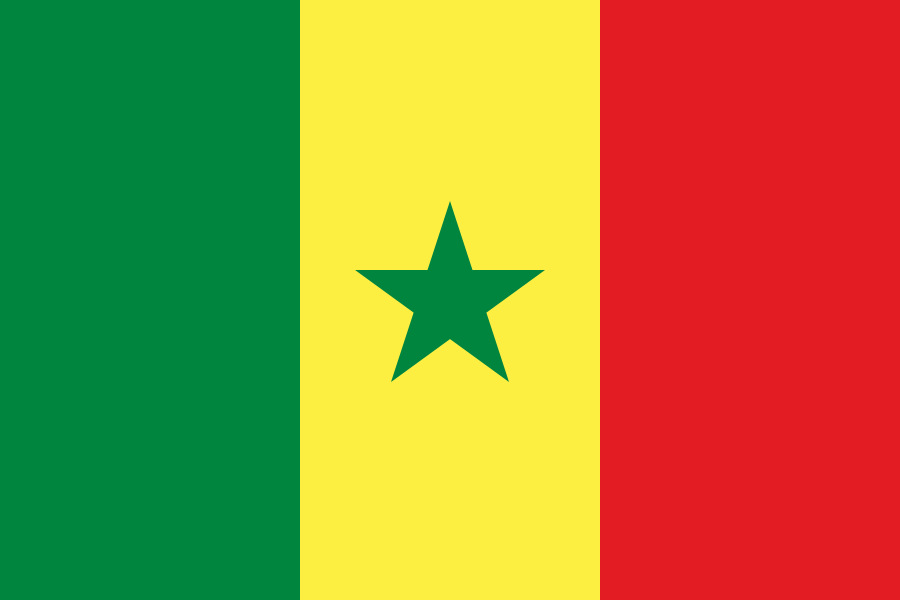
After the federation broke up, Senegal declared its independence on 20 August 1960. It kept the green, gold and red tricolour but replaced the kanaga with a green five-pointed star.
The Constitution describes the flag in its very first article: three equal vertical bands of green, gold and red, with a green five-pointed star in the centre.
Meaning of Colours & Emblems
Green, gold and red are the pan-African colours, inspired by the flag of Ethiopia, the symbol of a country that was never colonised. In Senegal, they are interpreted as follows:
- Green: hope, and the colour of the Prophet for Muslims.
- Gold: wealth, the arts and literature.
- Red: life, the sacrifice made by the nation and its determination to develop.
- Green star: unity and hope, as well as Senegal's openness to the five continents.
Anecdotes & Fun Facts
Senegal replaced the kanaga of the Mali Federation flag with a star partly because the depiction of a human figure could offend part of the Muslim population.
The flag of Mali, which also dropped the kanaga in 1961, uses the same colours in the same order, but without a star.
The Senegalese flag also resembles that of Cameroon, whose star is yellow, and that of Guinea, whose colours are arranged in reverse order.
Similar Flags Around the World


Sport and history
National teams
Olympic Games
Frequently asked questions
What is the capital of Senegal?
Dakar is the capital of Senegal.
What do the colours of the flag of Senegal mean?
Green, gold and red are the pan-African colours, inspired by the flag of Ethiopia, the symbol of a country that was never colonised. In Senegal, they are interpreted as follows: Green: hope, and the colour of the Prophet for Muslims. Gold: wealth, the arts and literature. Red: life, the sacrifice made by the nation and its determination to develop. Green star: unity and hope, as well as Senegal's openness to the five continents.
Which countries border Senegal?
Senegal shares land borders with: Mauritania, Mali, Guinea, Guinea-Bissau, Gambia.