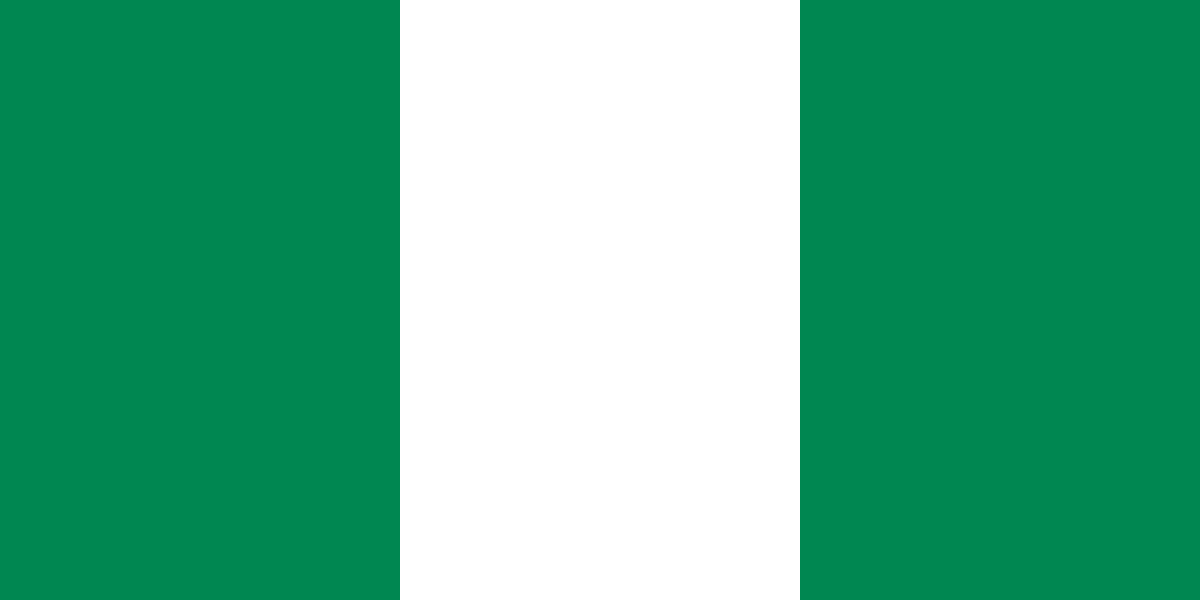
Adopted in 1960
| Capital | Abuja |
|---|---|
| Population | 232 679 478 inh. |
| Area | 923 770 km² |
| Population density | 251.9 inh./km² |
| Local time | --:-- |
| Language(s) | English |
| Political system | Federal presidential republic |
| National motto | Unity and Faith, Peace and Progress |
| National anthem | Arise, O Compatriots |
| Currency | Nigerian naira (NGN) |
| Land borders | Benin, Cameroon, Niger, Chad |
| Maritime borders | Gulf of Guinea |
The flag: history and symbolism
Flag History
The flag of Nigeria came out of a competition held in 1959, as independence approached. From the many entries received, the judges chose that of Michael Taiwo Akinkunmi, a 23-year-old Nigerian student who was then studying engineering in London.
His design originally included a radiant red sun in the centre of the white band. The judges removed it, keeping only three vertical bands, green, white and green.
The flag was raised for the first time on 1 October 1960, the day Nigeria, a former British colony, became independent, and has not changed since.
Meaning of Colours & Emblems
The colours of the Nigerian flag have a simple meaning:
- Green: agriculture and the country's natural wealth, as its economy then relied largely on the land.
- White: peace and the unity of the nation, which brings together several hundred peoples.
The judges considered unnecessary the red sun of the original design, which was meant to evoke divine protection over the country.
Anecdotes & Fun Facts
Michael Taiwo Akinkunmi, who long remained unknown, was honoured late in life and nicknamed ‘Mr Flag Man’. He died in 2023, aged 87.
The green of the flag is also that of Nigeria's national teams, such as the Super Eagles in football, Olympic champions in 1996.
With only two colours, the flag of Nigeria is one of the most understated in Africa.
Flags of Neighbouring Countries


Sport and history
Olympic Games
Frequently asked questions
What is the capital of Nigeria?
Abuja is the capital of Nigeria.
What do the colours of the flag of Nigeria mean?
The colours of the Nigerian flag have a simple meaning: Green: agriculture and the country's natural wealth, as its economy then relied largely on the land. White: peace and the unity of the nation, which brings together several hundred peoples. The judges considered unnecessary the red sun of the original design, which was meant to evoke divine protection over the country.