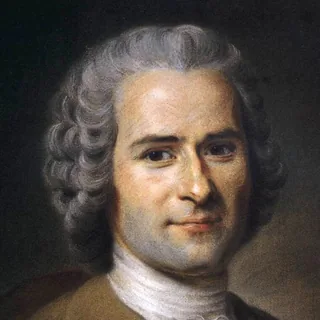
Key Facts
- 28 June 1712: born in Geneva
- 1750: Discourse on the Arts and Sciences, awarded a prize in Dijon
- 1755: Discourse on Inequality
- 1761: Julie, or the New Heloise
- 1762: The Social Contract and Emile, condemned in Paris and Geneva
- 2 July 1778: dies at Ermenonville
- 1794: remains transferred to the Panthéon
Biography
Jean-Jacques Rousseau (1712-1778), a French-speaking writer and philosopher from Geneva, was one of the most influential thinkers of the Enlightenment, as well as one of its critics. In The Social Contract he based sovereignty on the general will of the people; in Emile he renewed thinking on education; with Julie, or the New Heloise and the Confessions he paved the way for Romanticism and modern autobiography.
Born in Geneva on 28 June 1712, he lost his mother a few days after his birth and was brought up by his father, a watchmaker, who had him read novels and Plutarch very early. Apprenticed to an engraver, he left Geneva at fifteen, in 1728. He was taken in in Savoy by Madame de Warens, who led him to convert to Catholicism and became his patron. Self-taught, he studied music, philosophy and the sciences at Les Charmettes, near Chambéry.
Settling in Paris in 1742, where he presented a new system of musical notation to the Academy of Sciences, he became friends with Diderot and wrote articles on music for the Encyclopédie. In 1750 his Discourse on the Arts and Sciences, which won the prize of the Dijon academy, argued that the progress of the arts had corrupted morals and made him famous. His opera The Village Soothsayer was performed before the king in 1752. In the Discourse on Inequality of 1755 he asserted that man, naturally good, is corrupted by society and property.
In 1761 his novel Julie, or the New Heloise enjoyed immense success. The following year saw the publication of The Social Contract and Emile, a treatise on education containing a profession of faith judged contrary to religion. Both books were condemned in Paris and Geneva, and Rousseau had to flee. He took refuge in Switzerland and then in England with the philosopher David Hume, with whom he fell out. He lived with Thérèse Levasseur, with whom he had five children, all of whom were left at the Foundling Hospital.
In his last years, convinced that he was the victim of a plot, Rousseau wrote the Confessions, an account of his life published after his death, and the Reveries of the Solitary Walker. He died on 2 July 1778 at Ermenonville, north of Paris, a few weeks after Voltaire; his host, the Marquis de Girardin, had him buried on the Isle of Poplars in the park. The French Revolution, which saw The Social Contract as one of its sources, had his remains transferred to the Panthéon in 1794.
Sources: Wikipédia, « Jean-Jacques Rousseau »; Wikipedia, « Jean-Jacques Rousseau »
Related event
Also worth discovering
Last updated: