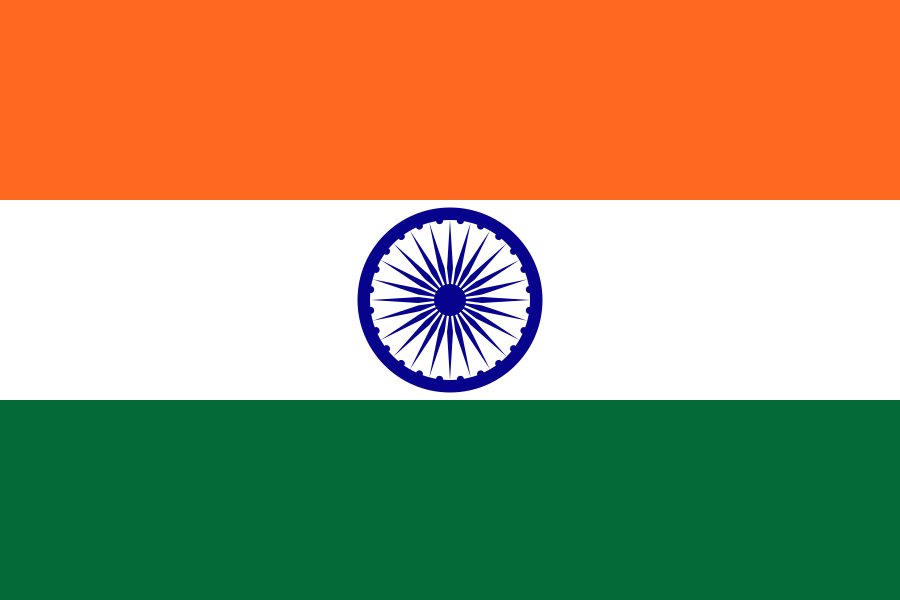
India: timeline and key events
-
Culture
Indus Valley Civilisation, Mohenjo-daro and Harappa
The Indus Valley Civilisation reaches its peak with planned cities such as Mohenjo-daro and Harappa, equipped with sewage systems, public baths and an undeciphered script, among the earliest urbanisations in history.
-
Culture
Birth of Buddha, Siddhartha Gautama
Siddhartha Gautama is born into the royal family of Lumbini (present-day Nepal), and after renouncing his privileges, attains Enlightenment under the Bodhi tree, founding Buddhism which spreads throughout Asia and beyond.
-
Politics
Maurya Empire, Chandragupta unifies North India
Chandragupta Maurya founds the first great Indian empire by unifying the northern subcontinent after Alexander the Great's departure, creating a centralised administration that will serve as a model for all subsequent Indian empires.
-
Culture
Reign of Ashoka, spread of Buddhism
Emperor Ashoka, after the bloody conquest of Kalinga, converts to Buddhism and spreads its non-violent precepts through edicts engraved throughout India, becoming one of the greatest emperors in history.
-
Culture
Beginning of the Gupta Empire, golden age of Indian culture
The Gupta Empire inaugurates a golden age of Indian civilisation: mathematics (invention of zero, the decimal system), astronomy, Sanskrit literature with Kalidasa, and flourishing art radiate throughout Asia.
-
Politics
Muslim conquest, Delhi Sultanate
Muhammad of Ghor defeats the Hindu king Prithviraj III at the Battle of Tarain, opening the way for Muslim domination of northern India with the Delhi Sultanate, which introduces Islam and transforms Indian culture.
-
Politics
Foundation of the Mughal Empire by Babur
Babur, a descendant of Tamerlane and Genghis Khan, wins the First Battle of Panipat and founds the Mughal Empire, which will govern most of India for more than three centuries and create an exceptional cultural legacy.
-
Culture
Reign of Akbar the Great, Mughal apex
Emperor Akbar extends the Mughal Empire to almost the entire subcontinent, advocates religious tolerance, develops the arts and administration, and makes the Mughal court a culturally radiant centre on a global scale.
-
Economy
Creation of the British East India Company
Queen Elizabeth I grants a royal charter to the East India Company, which starts with trade and ends up exercising political and military sovereignty over much of India.
-
War
Battle of Plassey, beginning of British domination
Robert Clive wins the Battle of Plassey thanks to the treachery of an Indian general, allowing the East India Company to take control of Bengal and laying the foundations for British colonial domination over India.
-
War
Sepoy Mutiny, first independence uprising
Indian soldiers (sepoys) in the British army revolt, triggering a national insurrection that spreads throughout northern India; its bloody suppression by the British lastingly marks memories and accentuates nationalist sentiment.
-
Politics
Birth of Mahatma Gandhi
Mohandas Karamchand Gandhi is born in Porbandar (Gujarat); he will become the father of political non-violence (ahimsa) and the spiritual guide of the Indian independence movement, changing the course of world history.
-
Politics
Amritsar Massacre, turning point in the independence struggle
British soldiers fire on thousands of protesters gathered at the Jallianwala Bagh in Amritsar, killing at least 379 people; this event radicalises the nationalist movement and pushes Gandhi to fully commit to the independence struggle.
-
Politics
Gandhi's Salt March
Gandhi walks 390 km to the sea to collect salt as an act of civil disobedience against the British salt tax, triggering a mass non-cooperation movement and drawing worldwide attention to the Indian cause.
-
Politics
Indian Independence and Partition with Pakistan
On 15 August, Jawaharlal Nehru proclaims India's independence, ending two centuries of British rule; the simultaneous Partition with Pakistan causes mass displacement of 15 million people and inter-religious violence killing 500,000.
-
Politics
Assassination of Gandhi
Nathuram Godse, a Hindu extremist militant, shoots Gandhi in the chest in New Delhi on 30 January, causing worldwide mourning and depriving India of its moral guide at the most crucial moment in its history.
-
Politics
Proclamation of the Republic of India
The Indian Constitution comes into force on 26 January, making India the world's largest democracy; this visionary document guarantees fundamental rights and equality to 350 million citizens, despite the legacy of the caste system.
-
Science
India's first nuclear test (Smiling Buddha)
India detonates its first underground nuclear device in the Rajasthan desert, becoming the world's sixth nuclear power and asserting its strategic independence from the great powers in a Cold War context.
-
Economy
Economic reforms, liberalisation of India
Faced with a severe balance of payments crisis, Narasimha Rao's government undertakes radical reforms: opening to foreign investment, privatisations and the end of the licence system, triggering three decades of strong economic growth.