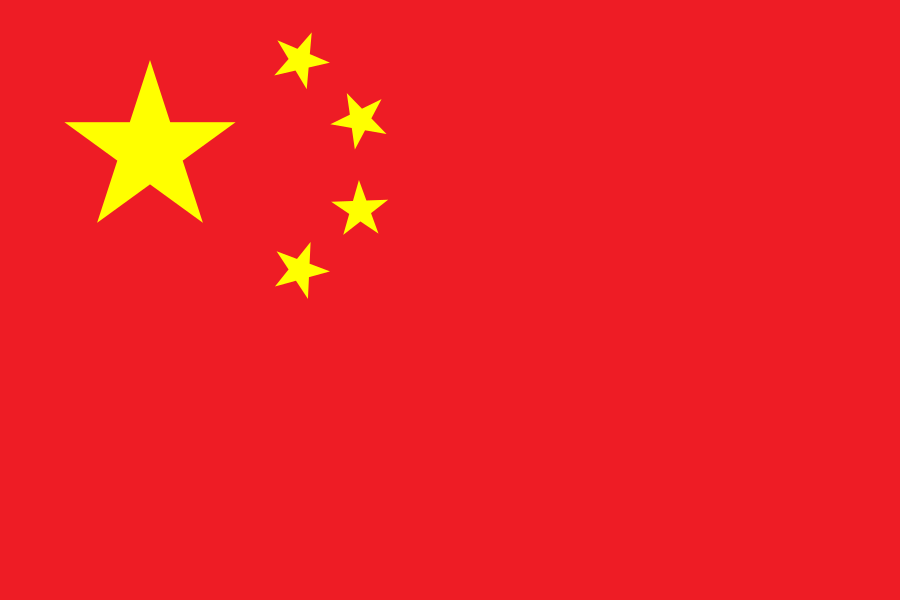
China: timeline and key events
-
Politics
Qin Shi Huang, first emperor of unified China
King Ying Zheng of Qin conquers the six rival kingdoms and proclaims himself Qin Shi Huang, first Son of Heaven of a unified China, establishing a centralised bureaucracy and the first standardised writing system.
-
Politics
Beginning of the Han Dynasty
After the fall of Qin, Liu Bang founds the Han Dynasty which reigns for four centuries, developing the Silk Road, consolidating Confucianism as a state philosophy and inaugurating a golden age of Chinese civilisation.
-
Economy
Opening of the Silk Road
Emperor Han Wudi sends Zhang Qian on a diplomatic mission to Central Asia, opening the trade routes that will become the Silk Road connecting China to the Mediterranean over 7,000 km.
-
Science
Invention of paper by Cai Lun
Court eunuch Cai Lun perfects the making of paper from tree bark, fishnets and rags, revolutionising written communication worldwide centuries later.
-
Culture
Beginning of the Tang Dynasty
Li Yuan founds the Tang Dynasty, considered the pinnacle of Chinese civilisation: poetry, painting, ceramics and trade reach new heights, and Chang'an becomes the world's largest city with a million inhabitants.
-
Politics
Foundation of the Yuan Empire by Kublai Khan
Genghis Khan's grandson Kublai Khan proclaims the Yuan Dynasty in China, unifying the country under Mongol rule and welcoming Marco Polo to his court, fostering exchanges between East and West.
-
Politics
Foundation of the Ming Dynasty and construction of the Forbidden City
Zhu Yuanzhang drives out the Mongols and founds the Ming Dynasty, which undertakes the construction of the Great Wall in its present form and the Forbidden City in Beijing, enduring symbols of imperial China.
-
Politics
Transfer of the capital to Beijing
Emperor Yongle transfers the capital from Nanjing to Beijing and officially inaugurates the Forbidden City, making Beijing the political, cultural and symbolic centre of China for the next six centuries.
-
Politics
Fall of the Ming, beginning of the Qing Dynasty
The Manchus breach the Great Wall and found the Qing Dynasty, the last Chinese imperial dynasty, which expands the Empire to its maximum extent and will reign until 1912.
-
War
First Opium War
China confiscates British opium, triggering the First Opium War; defeated, it signs the Treaty of Nanjing in 1842, ceding Hong Kong to Britain and opening five ports to foreign trade, beginning the "century of humiliation".
-
Politics
Fall of the Qing Dynasty, proclamation of the Republic
The last emperor Puyi abdicates, ending 2,000 years of imperial rule in China; Sun Yat-sen proclaims the Republic of China, opening a period of fragmentation and civil wars.
-
Politics
Foundation of the Chinese Communist Party
Mao Zedong and twelve delegates found the Chinese Communist Party in Shanghai, initiating a revolutionary process that will lead to the seizure of power in 1949 and the profound transformation of China.
-
War
Japanese invasion and Nanjing Massacre
Japan invades China on a large scale; the fall of Nanjing in December is accompanied by a mass massacre claiming between 100,000 and 300,000 civilian victims, a foundational trauma in Chinese national memory.
-
Politics
Proclamation of the People's Republic of China
Mao Zedong proclaims the People's Republic of China from Tiananmen Square on 1 October, after the communist victory over the nationalists, marking the beginning of a new era for the world's most populous country.
-
Politics
Cultural Revolution
Mao Zedong launches the Cultural Revolution, plunging China into ten years of chaos: intellectual elites persecuted, cultural heritage destroyed, the economy devastated and millions of victims.
-
Economy
Deng Xiaoping's economic reforms
Deng Xiaoping commits China to the policy of opening and reform (Gaige Kaifang), introducing a market economy while maintaining the one-party system, triggering the most spectacular economic growth in history.
-
Politics
Tiananmen Square crackdown
The government sends troops and tanks to disperse pro-democracy protesters gathered at Tiananmen Square for weeks, killing hundreds to thousands and shocking the international community.
-
Economy
China's entry into the WTO
China joins the World Trade Organisation, fully integrating into the global economy and accelerating its growth to become the world's second-largest economy in less than twenty years.
-
Sport
Beijing Olympic Games
China hosts the Summer Olympics in Beijing, finishing first in the gold medal table with 51 titles, and presenting its rise to power to the world with a spectacular opening ceremony.
-
Economy
Launch of the Belt and Road Initiative
President Xi Jinping announces the Belt and Road Initiative (BRI), a colossal infrastructure project aimed at connecting China to Eurasia and Africa through roads, ports and railways, for an investment of several trillion dollars.